Spices are an important part of the daily diet. They add aroma, flavour, and colour to food, but an attractive appearance does not always guarantee a product’s quality or safety. Spice adulteration is a significant food-safety challenge, particularly when unauthorized synthetic dyes are used to enhance a product’s colour.
Adulteration is often motivated by economic gain. A manufacturer or supplier may replace an expensive raw material with cheaper ingredients, conceal the product’s composition, or artificially intensify its colour to make the spice appear to be of higher quality. Such violations are especially difficult to detect in ground spices and multi-ingredient blends because it is almost impossible to assess their composition visually.
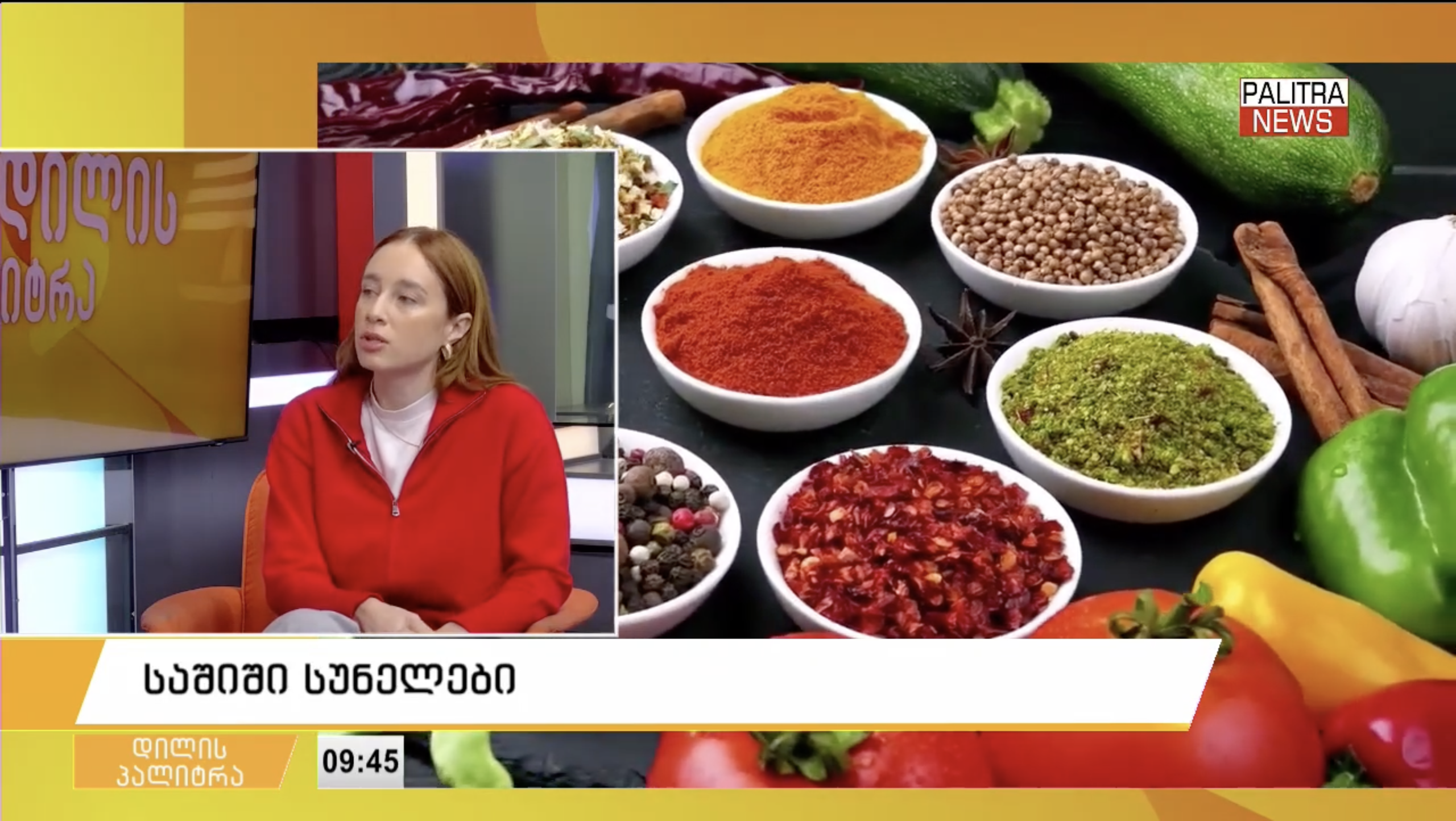
The risk of adulteration is often discussed in relation to red pepper, paprika, turmeric, saffron, and various spice blends. However, this does not mean that every such product is adulterated or that violations occur with equal frequency in all these spices on the Georgian market. As part of risk-based official food-safety controls, the laboratory testing of 177 samples of various products for prohibited Sudan dyes is planned in 2026.
Synthetic dyes such as Sudan I, Sudan II, Sudan III, Sudan IV, and Sudan Red G warrant particular attention. They do not occur naturally in food, and their use for colouring spices is prohibited. One possible reason for adding these substances is to artificially intensify the colour of red pepper and other spices.
Their potential health risks are associated with the chemical properties of each particular dye and its possible effects on the body. Some of these substances have demonstrated genotoxic potential in experimental studies. Genotoxicity refers to the ability to damage genetic material, including DNA. If such damage is not properly repaired, mutations may develop, some of which can contribute to the development of cancer.
For example, the International Agency for Research on Cancer (IARC) has classified Sudan I as possibly carcinogenic to humans—Group 2B. This classification indicates a potential hazard, but it does not mean that consuming a product containing the dye on a single occasion will necessarily cause cancer. Assessing the risk requires consideration of the substance’s concentration, the dose consumed, and the duration of exposure.
It is important to distinguish between a hazard and a risk. A hazard refers to a substance’s potentially harmful properties, whereas risk depends on the extent and conditions of a person’s exposure to that substance. Nevertheless, the use of Sudan dyes in food is prohibited, and their detection requires an appropriate response as part of official controls.
The relevance of the issue is confirmed by information published by Georgia’s National Food Agency in 2026. According to the Agency, 94 spice samples were collected during the year for testing for Sudan dyes, and prohibited dyes were detected in five of them. This represents a detection rate of approximately 5.3% among the tested samples.
In September, the Agency issued a statement concerning 44 samples collected from various retail outlets across the country. The list of non-compliant products included red pepper, two different batches of Svan salt, and a seasoning mix for minced meat. Laboratory testing detected Sudan I, Sudan IV, and Sudan Red G.
According to the Agency, the business operators concerned were prohibited from selling the affected products, and procedures were initiated to remove and recall them from the market.
Products containing Sudan dyes should not be consumed by anyone. Particular caution is necessary for children, pregnant women, and people who consume spices regularly.
For children, consuming the same quantity of a substance may result in a higher dose relative to their body weight. During pregnancy and infancy, it is especially important to minimize unnecessary exposure to potentially harmful chemicals. However, there is insufficient evidence to prove that Sudan dyes necessarily cause a specific disease in all these groups or that their effects are the same in every case.
It is also important to understand that frequent spice consumption does not automatically result in harm to health. The concern is the repeated consumption of a contaminated product, which may increase the body’s level of exposure.
A functioning HACCP system plays an important role in reducing the risk of spice adulteration. It includes selecting reliable suppliers of raw materials, inspecting incoming spices, ensuring traceability, and assessing potential chemical hazards.
Planning laboratory tests based on risk assessment is particularly important for the timely detection of prohibited substances such as Sudan dyes. However, a HACCP system alone cannot guarantee the complete prevention of adulteration. To be effective, it must operate alongside supplier controls and appropriate laboratory testing.
Consumers should give preference to properly packaged and labelled products that identify the manufacturer and provide a list of ingredients, batch number, and expiry date. Products should preferably be purchased from reliable retailers, and consumers should periodically check official food-safety alerts.
An unusually intense colour may be a reason for suspicion, but it is impossible to identify a prohibited dye by colour alone. Smelling, washing, or heating a product are not reliable methods for detecting or removing Sudan dyes. Appropriate laboratory testing is required to identify them.
Georgia’s National Food Agency performs the primary market-control function. Risk-based inspections, laboratory testing, product traceability, and prohibiting the sale of non-compliant products are essential to prevent hazardous products from reaching consumers.
Moore, J. C., Spink, J., & Lipp, M. (2012). “Development and Application of a Database of Food Ingredient Fraud and Economically Motivated Adulteration from 1980 to 2010.” Journal of Food Science, 77(4), R118–R126. DOI: 10.1111/j.1750-3841.2012.02657.x.
International Agency for Research on Cancer (IARC)-IARC Monographs on the Identification of Carcinogenic Hazards to Humans. The classification of each individual dye should be verified in the relevant monograph; assigning a single classification to all Sudan dyes would be incorrect.
European Food Safety Authority (EFSA)-scientific assessments concerning prohibited dyes in food and their genotoxic potential.
National Food Agency of Georgia-official information published in 2026 concerning the detection of Sudan dyes in spices.

We help your company meet international standards and legal requirements — from implementation to audit.
**Implementation of the HACCP system in cooperation with the quality consulting center includes the step-by-step implementation of the following works: **On-site study of the enterprise's infrastructure and inventor...
Read more"Boost your business success with ISO 9001 certification! Our organization specializes in providing comprehensive ISO 9001 certification and training solutions. Achieving ISO 9001 certification demonstrates your commitme...
Read moreHACCP Audit Services Ensure your food safety system is robust and compliant with our expert HACCP audit services. Our professional auditors provide thorough evaluations of your Hazard Analysis and Critical Control Poi...
Read more