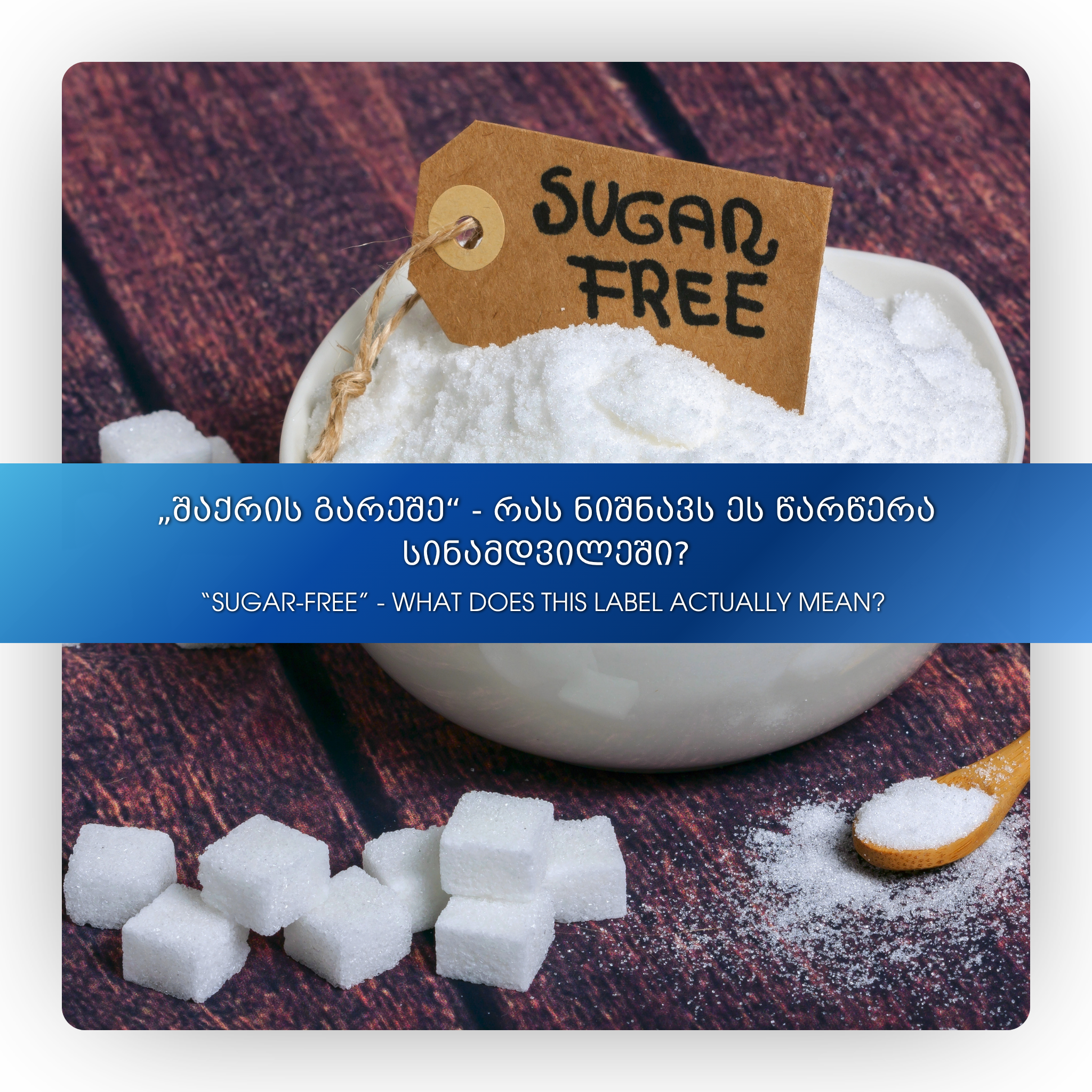
A product says “sugar-free” on the front of the package. At first glance, the message seems obvious: no sugar.
Legally and nutritionally, however, the reality is more nuanced.
In Georgia, the use of nutrition claims such as “sugar-free,” “low sugar,” and “no added sugars” is regulated by Government Resolution No. 510 of 17 November 2016, which entered into force on 1 March 2018 and is aligned with Regulation (EC) No. 1924/2006.
The applicable rules distinguish between three different claims:
“Sugar-free” may be used only if the product contains no more than 0.5 g of sugars per 100 g or 100 ml.
“Low sugar” means no more than 5 g of sugars per 100 g for solid foods or 2.5 g per 100 ml for liquids.
“No added sugars” means that no mono- or disaccharides, or other foods used for their sweetening properties, have been added to the product. If sugars are naturally present, the label must indicate that the product contains naturally occurring sugars.
This distinction is important.
A product labelled “sugar-free” does not necessarily contain zero sugar. It may still contain a small amount, provided that it remains within the legally permitted threshold.
Likewise, “no added sugars” does not mean “no sugar.”
A familiar example is 100% fruit juice.
A manufacturer may not add any refined sugar during production, yet the juice can still naturally contain a substantial amount of sugar.
Depending on the fruit, 100 ml of juice may contain around 10 g of naturally occurring sugars — an amount that can be close to the sugar content of some soft drinks.
This does not mean that fruit juice and soft drinks are nutritionally identical. But from the perspective of sugar intake and blood glucose, they may be more similar than the wording on the front of the package suggests.
That is precisely why the rules require a statement such as “contains naturally occurring sugars” where appropriate.
The purpose is simple: to prevent consumers from interpreting “no added sugar” as “no sugar at all.”
The answer is usually sweeteners.
Food and beverage manufacturers often use sweeteners to reduce or replace sugar while maintaining sweetness.
These can broadly include:
high-intensity sweeteners such as aspartame, sucralose, acesulfame K and steviol glycosides; and
sugar alcohols, or polyols, such as xylitol and sorbitol.
Some of these substances are many times sweeter than sugar, which means only a relatively small amount is needed to achieve the desired taste.
But replacing sugar with a sweetener does not automatically turn a product into a healthier one.
In 2023, the World Health Organization (WHO) issued guidance advising against relying on non-sugar sweeteners as a long-term strategy for controlling body weight.
The recommendation was based on evidence suggesting that long-term use of non-sugar sweeteners does not provide a meaningful benefit for reducing body fat in the general population.
This point is sometimes misunderstood.
The WHO recommendation does not mean that all sweeteners are inherently unsafe.
It also does not apply in the same way to people with diabetes or to the management of existing medical conditions.
The safety of a particular sweetener depends on the substance itself, the amount consumed and the relevant acceptable daily intake established by food-safety authorities.
Not necessarily.
One of the most common mistakes consumers make is to treat a single nutrition claim as a general health rating.
A sugar-free biscuit, chocolate bar or dessert may still contain significant amounts of:
calories;
fat;
saturated fat; and
salt.
Removing or reducing sugar can also change the texture and structure of a product.
To compensate, manufacturers may use other ingredients to preserve flavour, volume or consistency.
As a result, a product with less sugar is not automatically lower in calories or nutritionally superior overall.
The more useful question is not simply:
“Does it contain sugar?”
but rather:
“What does the product contain as a whole?”
Yes.
Blood glucose is influenced by more than the amount of sugars listed on the label.
A product may contain starch or other digestible carbohydrates, which are broken down into glucose in the body.
For people with diabetes or impaired glucose metabolism, looking only at the line marked “of which sugars” may therefore be misleading.
The product’s total carbohydrate content can be equally important.
Different sweeteners also behave differently in the body, so they should not all be treated as metabolically identical.
A front-of-pack claim should be treated as a starting point, not as the full nutritional picture.
A more useful approach is to check several things together:
Sugars per 100 g or 100 ml
Total carbohydrates
Ingredient list
Sweeteners used
Energy value
Serving size
Serving size is especially easy to overlook.
A drink may contain only a modest amount of sugar per 100 ml, but if the bottle contains 500 ml and is consumed at once, the actual intake is five times higher.
The same principle applies to calories, carbohydrates and sweeteners.
There is no need to divide these products automatically into “good” and “bad” categories.
Sugar-free or no-added-sugar products can be useful where they help reduce overall intake of free or added sugars.
But the label should not be interpreted as permission for unlimited consumption.
The WHO recommends that adults and children keep free sugar intake below 10% of total daily energy intake, with a further reduction to below 5% potentially providing additional health benefits.
The words “sugar-free” tell you something specific about the sugar content of a product.
They do not tell you everything you need to know about its nutritional value.
A product can be sugar-free and still be high in calories, fat, salt or carbohydrates. It can contain sweeteners. It can affect blood glucose. And “no added sugar” can still mean that a product naturally contains a considerable amount of sugar.
The most reliable approach is simple:
Do not judge the product by one phrase on the front of the package. Read the nutrition declaration and ingredient list as a whole.
Government of Georgia Resolution No. 510 of 17 November 2016 - Rule on the Placement of Nutrition and Health Claims on Foods
Regulation (EC) No. 1924/2006 on nutrition and health claims made on foods
Regulation (EU) No. 1169/2011 on the provision of food information to consumers
World Health Organization - Use of Non-Sugar Sweeteners: WHO Guideline (2023)
European Food Safety Authority - guidance and scientific opinions on sweeteners and dietary reference values